A crypto DCA strategy replaces repeated timing decisions with a written purchase schedule. Start by separating money already available from contributions you will earn later.
The first decision in a crypto DCA strategy is not daily versus monthly buying. It is whether the investment money is already available or arrives gradually with your income. Both situations can use scheduled purchases, but only one involves deliberately holding existing cash back. Separating them makes the comparison clearer and keeps the plan tied to an affordable budget.
What does dollar-cost averaging do?
Dollar-cost averaging puts a fixed monetary amount into an asset at regular intervals. The number of coins changes with the price. Buying an identical coin quantity each month is a different plan because the cash required changes.
FINRA’s explanation of DCA distinguishes staged investment of an available lump sum from contributions made as money is earned. A worker investing part of each paycheck cannot invest next month’s earnings today. Someone with the full amount available is choosing to delay part of their market exposure.
At KriptoMeta, we judge DCA as an execution discipline, not a way to identify the bottom. A useful plan specifies an affordable budget, keeps fees visible and includes a date for reviewing the reason for owning the asset. An average purchase price alone says little about whether the plan still fits.
Write down four decisions before buying
- Budget: Choose an amount you can maintain after essential expenses and near-term cash needs. Include a rule for reducing or pausing contributions if income changes.
- Schedule: Match purchases to your cash flow. A monthly paycheck can support a monthly purchase; weekly purchases require more frequent records and sufficient funds on each date.
- Execution: Record the trading pair, order method and fee schedule. Compare the total quote from an automatic-buy service with a spot order rather than assuming they cost the same.
- Review: Set a date, such as three months later, to examine spending, average cost and adherence. A scheduled review is easier to audit than a plan rewritten after every price move.
Decide how to handle a failed purchase as well. Making it up the next day and skipping it until the next scheduled date produce different records. For the initial order steps, use our guide to buying cryptocurrency. Avoid doubling the next order on impulse; apply the catch-up rule you wrote when setting the budget.
A three-purchase cost example
Worked example: Three purchases of a hypothetical asset use $300 each. Prices are $100, $80 and $120. Fees are excluded from the initial calculation.
| Purchase | Price | Budget | Units received |
|---|---|---|---|
| 1 | $100 | $300 | 3 |
| 2 | $80 | $300 | 3.75 |
| 3 | $120 | $300 | 2.50 |
| Total | — | $900 | 9.25 |
Average cost = $900 / 9.25 = $97.30 per unit. The simple average of the three quoted prices, $100, does not give the cost of equal-dollar purchases. At the final $120 price, the holding is worth 9.25 × $120 = $1,110. Combine your own fills in the average cost calculator to apply the same quantity-weighted approach.
DCA versus a lump sum: Keep the comparison fair
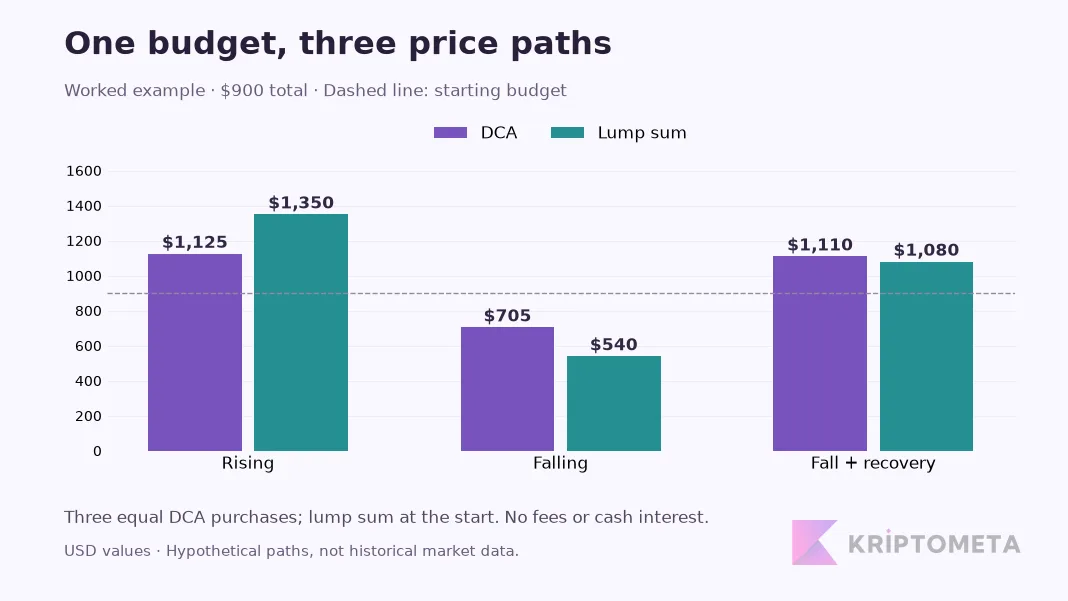
Give both methods the same total cash and ending date. In the examples below, $900 is available at the outset. The lump sum buys immediately; DCA spreads it across three $300 purchases. There is no interest on waiting cash and no trading fee.
| Price path | DCA ending value | Lump-sum ending value |
|---|---|---|
| $100 → $120 → $150 | $1,125 | $1,350 |
| $100 → $80 → $60 | $705 | $540 |
| $100 → $80 → $120 | $1,110 | $1,080 |
The rising path rewards earlier exposure. The falling path lets later DCA purchases buy more units, although both portfolios finish below their starting budgets. Compare several market paths rather than selecting the one historical window that makes your preferred method look best.
The KriptoMeta historical DCA calculator lets you choose a coin, date range, purchase frequency, USDT budget per purchase and fee. For a lump-sum comparison, use the sum of all recurring contributions as the single purchase amount. It uses daily UTC opening prices for purchases and the selected final day’s close for valuation. The purchase log shows exactly which dates and quantities form the result.
Choose frequency and fees together
More frequent buying is not automatically better. With a purely proportional 0.10% fee, $900 of total purchases costs $0.90, assuming no minimum charge or rounding effect. Splitting that total into more orders does not, by itself, increase the percentage fee. A hypothetical fixed $0.50 charge is different: three orders cost $1.50, while twelve cost $6. Minimum charges and quoted spreads matter most when individual purchases are small.
If fees come out of the purchase budget, a $300 order with a 0.10% fee invests $299.70. At a $100 asset price, that buys 2.997 units. Use the checks in our exchange trading fee comparison to compare the actual order method and quote you plan to use.
When should the plan change?
Revisit the plan if income falls, a near-term cash need develops or the reason for holding the asset changes. A cheaper price does not repair a broken ownership case. Separate the appeal of lowering the average shown in your account from the reason for making the next purchase.
At each review, record the planned budget, actual spending, accumulated units and total fees. A consistent crypto transaction record makes missed or duplicated orders easier to spot. DCA controls the timing of new money. Deciding how much of an existing portfolio each asset should occupy is a separate allocation task.
As purchases accumulate, check allocation drift with the threshold and contribution calculations in our portfolio rebalancing guide. Keep the purchase schedule and the allocation decision in separate records.