












Coinbase pairs simple purchases with a more detailed Advanced order book. The useful comparison is what an eligible US account can do, what reaches the destination after costs, and when funds can leave the platform.
Coinbase is easiest to assess when the purchase route is specified first. A simple quoted trade and an Advanced order-book trade offer different controls and can leave different amounts of crypto after costs. For a US customer choosing between them, the useful comparison runs from the initial dollar budget through execution to the funds that can actually be withdrawn. The exchange-cost comparison provides a worked budget example that separates commission, execution price and withdrawals without counting the same spread twice.
What we examined and who this review is for
On September 27, 2026, we inspected the public Coinbase Advanced BTC-USD screen and current official documentation. We opened the depth view, order book and execution controls without signing in. We did not fund an account, submit trades, complete identity checks, time support responses or test withdrawals. The cost calculation below is hypothetical, not a quote from Coinbase.
This edition addresses eligible US spot customers. Payment methods, assets and features can vary by state and account. Coinbase’s entity and licensing guidance directs customers to the terms applicable to their own account. A page being accessible does not establish eligibility for every service advertised on it. Derivatives, stocks and institutional Prime services are outside this review.
The public trading screen uses Coinbase’s en-gb route. The image documents visible interface controls; it is not evidence of US account approval. US payment and balance information below comes from the corresponding help documents, rather than the screen’s regional address.
Simple trading, Advanced and self-custody serve different jobs
The main Coinbase exchange account uses platform-managed custody. Advanced provides more detailed trading controls within that account; switching the interface does not move assets into a wallet whose keys you control. The distinction between custodial and non-custodial wallets matters more than the shared brand name.
| Route | What you inspect | Decision trade-off |
|---|---|---|
| Simple buy or sell | Quoted price, disclosed charges and resulting amount | Fewer controls simplify the purchase, but the all-in quote still needs comparison. |
| Coinbase Advanced | Market pair, order type, limit and execution conditions | More control over execution also creates room for an incorrectly configured or unfilled order. |
| Self-custody / DEX | Wallet, network and onchain transaction | A different custody model with separate asset and transaction risks; not equivalent to a centralized spot balance. |
Coinbase’s Advanced overview says a subscription is not required. Advanced should not be confused with the Coinbase One subscription. Someone making a first purchase may find the budget and custody decisions in our first crypto purchase guide more useful than starting with chart indicators.
Reading the actual Advanced screen
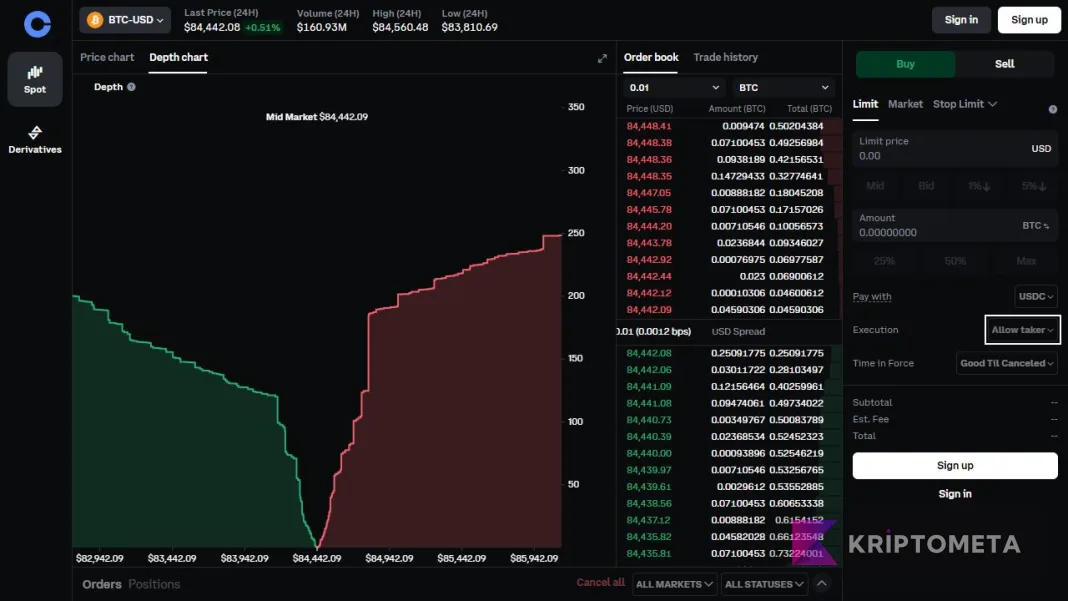
Source: Coinbase’s public English Advanced page, captured September 27, 2026, through the en-gb route. Prices belong to the capture moment. We were signed out, so personal fee and balance fields were empty. The image is not a US account or availability test.
- Market pair at the top: BTC-USD identifies the quoted market. Read “Pay with” in the order form too: a USD price display and a USDC funding option do not turn dollars and USDC into the same asset.
- Depth on the left, order book in the middle: The steps represent resting orders. Liquidity can change before an order arrives, so the displayed depth does not guarantee execution.
- Order controls on the right: Read the limit price, size, execution instruction and time in force together. The price field alone does not describe what the order will do.
- Totals below the form: Review the fee and total with an eligible signed-in account. Dashes on our public screen cannot be used to infer a customer’s fee tier.
The layout makes price and execution conditions visible together. Its cost is a learning curve: an unfamiliar “Allow taker” setting can matter more to the final charge than a familiar chart. The price chart did not render in our session, while the depth chart and book did. That limited observation is not a platform-wide uptime or speed measurement.
A limit order does not automatically earn maker fees
Coinbase’s order documentation distinguishes “Post only” from “Allow taker.” Post only is intended to leave an order on the book and can reject it if it would match immediately. Allow taker permits immediate execution. A buy limit sets the highest acceptable price; it does not promise that the order will rest first.
In a hypothetical market with a best ask of $100, a $101 buy limit can immediately match the $100 offer. Choosing “limit” alone therefore does not establish maker status. A market order prioritizes execution over a fixed price. A stop-limit trigger also does not guarantee that the resulting sell order will fill.
Those choices make Advanced useful to someone who wants explicit execution control. For an occasional buyer unwilling to learn the distinctions, the same choices can create costly mistakes. A lower quoted fee is not a saving if the wrong order instruction undermines the intended purchase.
Compare the amount received, not just the fee percentage
The Advanced fee document uses maker/taker classification and trailing 30-day trading volume; the applicable tier is shown in the account. We do not copy an old percentage and present it as every reader’s current rate. Simple purchases may include a quoted spread. Advanced does not include that same Coinbase-added spread, but the market’s bid-ask gap and execution slippage still exist.
A practical comparison holds the budget and destination constant. The following numbers are deliberately hypothetical: they are neither Coinbase’s fee schedule nor a current Bitcoin quote. There is no currency conversion and no assumption that bank funding is free; any funding charge would have to be added separately.
| Item | Calculation | Result |
|---|---|---|
| Total budget | Assumed | $1,000 |
| Trading charge | Assumed charge reserved from budget | $6 |
| BTC purchased | $994 ÷ $50,000 per BTC | 0.01988 BTC |
| External send deduction | Assumed total deduction | 0.00002 BTC |
| BTC reaching the wallet | 0.01988 − 0.00002 | 0.01986 BTC |
| Effective acquisition cost | $1,000 ÷ 0.01986 | About $50,352.47 per BTC |
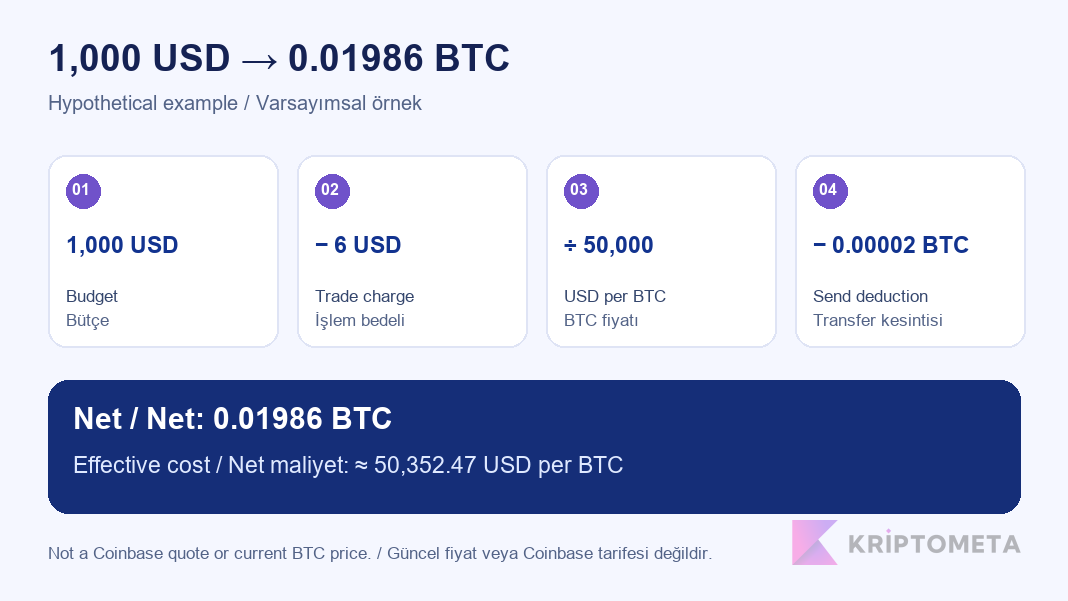
A competing quote with a smaller trading charge can still deliver less BTC if its execution price or send deduction is worse. The last line exposes that trade-off. If the intended destination is the exchange balance itself, exclude the external-send leg; comparing different end goals produces a misleading winner.
Coinbase’s fee disclosures also distinguish the estimated charge for an external send from the network fee ultimately paid. Batching and network conditions can make them differ. The entire fee visible for a batched blockchain transaction should not be treated as the deduction charged to one customer.
Buying power and withdrawable funds are different balances
According to the available balance guidance, crypto purchased with funds on hold may be traded within Coinbase while remaining unavailable to send off-platform. The account value, amount usable for a trade and amount available to withdraw answer different questions. A universal waiting period would be misleading.
For US accounts, Coinbase’s payment-method table lists options including ACH bank funding, debit cards and wire transfers, with different purposes and processing times. Eligibility and any existing holds still matter. If the plan is to buy and immediately fund an external wallet, inspect the available-to-send amount before placing the purchase, not after it.
Once sending is available, match the destination network and address as carefully as the asset ticker. Our crypto transfer guide covers those checks. Advanced portfolio users have another distinction to watch: the official portfolio documentation requires moving funds back to Primary before sending or withdrawing. An internal portfolio move is not an onchain transfer.
Security: what the brand name cannot establish
Centralized custody reduces the need to manage private keys personally, but makes access and withdrawals dependent on the platform. Coinbase’s insurance overview states that crypto does not have FDIC or SIPC protection and that crime insurance does not cover every possible loss. US cash protections depend on how funds are held and the applicable conditions; they are not protection against Bitcoin price declines or a blanket guarantee of the exchange balance.
Past incidents belong in the decision too. In its May 15, 2025 disclosure, Coinbase reported that some overseas support workers had been bribed to steal customer data. The company said passwords and private keys were not exposed, but the stolen information enabled social engineering. “No private keys were stolen” does not mean that customers faced no risk.
Our assessment separates useful controls from assurances we cannot test. Strong authentication and withdrawal address restrictions can help, yet a customer persuaded to transfer funds to an impostor’s “safe wallet” can still lose assets. We did not perform a penetration test or independently audit Coinbase’s custody systems.
Who Coinbase suits, and when to look elsewhere
- A plausible fit: An eligible US customer who wants to move from quoted purchases to order-book trading and is prepared to inspect execution, all-in costs and funding holds.
- A poor fit for a specific need: Someone who requires guaranteed immediate off-platform transfers after every deposit, needs an unsupported asset or wants personal key control over every balance.
- Useful strength: The trading workspace brings market depth and explicit order conditions together, supported by documentation that separates trading, funding and custody concepts.
- Material limitation: Exact pricing needs an account-specific quote, availability varies, withdrawal holds can affect the plan, and centralized custody remains a counterparty dependency.
For another order-book workflow, compare our Kraken Pro review using the same criteria. We do not claim an untested speed or security advantage for either service. The broader US crypto exchange comparison helps narrow eligible alternatives. Coinbase’s popularity earns it a place in the comparison; the actual account terms, net cost and exit route determine whether it fits.