














An overwhelming approval rate can conceal concentrated voting power. Participation, treasury commitments and the authority to execute a decision need separate evidence.
DAO governance analysis needs more than an approval percentage. Who supplied the decisive votes? What can opponents do before execution? Who can actually move treasury assets? A proposal with 99% support can represent broad agreement or the preferences of a few heavily weighted addresses.
We examine a closed SafeDAO SEP 55 vote alongside Lido’s separation of decision-making and opposition rights. The former supplies an observed distribution; the latter illustrates an execution safeguard. Documents were checked on September 28, 2026. SafeDAO figures come from the closed result recorded on September 27. One vote is not a protocol-wide decentralization or safety score.
Five questions behind a DAO decision
A DAO can coordinate collective decisions without giving everyone equal influence. A governance token’s voting rights depend on the chosen rules, delegation and measurement time. Economic consequences require another layer of evidence.
| Question | Evidence to inspect | Insufficient shortcut |
|---|---|---|
| Who participated? | Addresses, delegation relationships and participation over time | Counting addresses as people |
| Who determined the outcome? | Largest voting shares and the majority rule | The approval percentage alone |
| Was participation sufficient? | Quorum definition, eligible vote types and reference block | Applying one universal turnout percentage |
| Who can execute? | Timelock, executor contract or signing authority | An “accepted” label |
| How will funds be spent? | Recipient, denomination, milestones and reporting | The treasury’s displayed dollar value |
SafeDAO: 93 ballots, concentrated voting power
The closed SEP 55 Safenet Beta proposal showed 93 votes and approximately 99.94% acceptance. The largest address supplied 57.445% of voting power and the second supplied 15.692%. Together they accounted for 73.137%. Strong support did not establish a widely distributed decision.
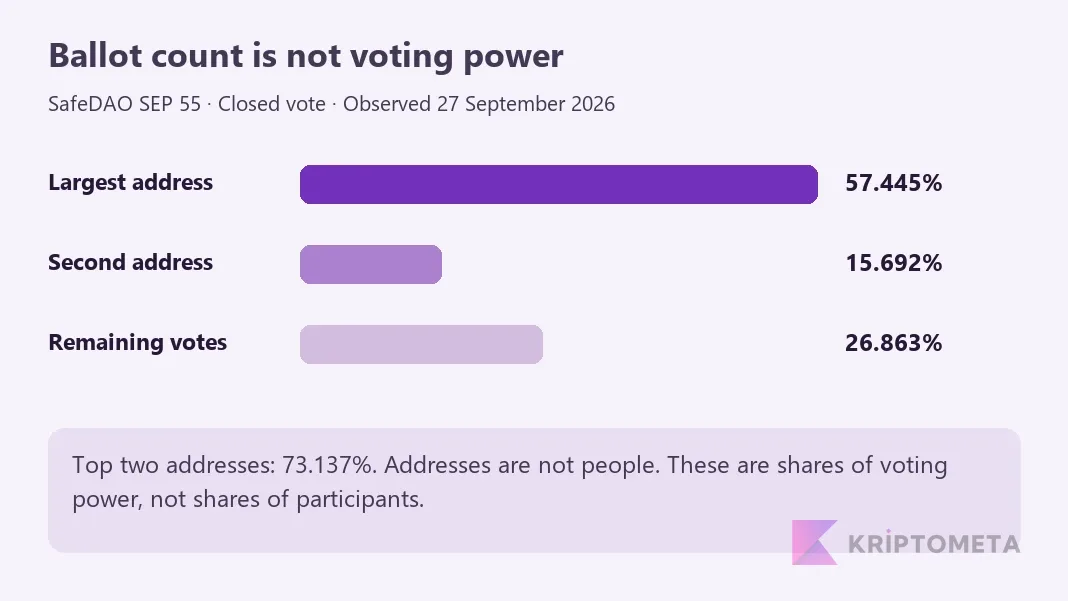
Apply the remaining 26.863% to the approximately 33.2 million voting power displayed, and the remainder is about 8.9 million. Compare that with the displayed 10 million quorum. This is an arithmetic sensitivity check: it shows how much the recorded participation depended on two addresses. It does not prove the proposal would have failed without them; other participants or delegators might have behaved differently.
A large delegate can represent many token holders. Treating the address as one investor would conceal that distinction, while assuming every delegate represents an independent constituency would be equally unsupported. Snapshot’s delegation documentation explains the representation mechanism. Our Snapshot review covers the interface and proposal-reading workflow separately.
Quorum and majority answer different questions
Quorum tests sufficient participation; a majority rule tests the outcome among options. Which votes count toward quorum varies. OpenZeppelin’s governance modules support different counting rules, including models that count votes for and abstentions toward the threshold.
Consider a hypothetical quorum of 1,000 voting units, with for, against and abstain all counting toward participation. A result of 600 for and 200 against has 75% support among decisive votes, but only 800 participating units. It misses quorum. Another 200 abstaining units would meet the participation threshold without changing the for-to-against ratio. Change the counting rule and the result may change too. Read the rule before interpreting the percentage.
Lido separates voting power from opposition rights
Lido’s current governance description assigns decision-making to LDO holders while stETH holders can signal opposition through Dual Governance. Its stated thresholds use opposition above 1% of total stETH supply to delay execution and above 10% to trigger an exit-related process. The mechanism creates time between a supported decision and its effect on stakers.
Opposition rights are neither LDO votes nor an unconditional permanent veto. State transitions, waiting periods and withdrawals matter. The Dual Governance state guide also describes a cooldown state in which pending proposals can execute. Saying stETH holders can block every decision indefinitely would overstate their authority.
SafeDAO supplies an example of measured concentration; Lido supplies an example of a safeguard designed around potentially contentious decisions. We are not ranking their safety with a shared score. Our Lido and LDO economic analysis addresses a separate question: how protocol activity relates to the token.
Treasury size is not the same as spending capacity
A proposal’s budget is only part of the commitment. The recipient, payment conditions and asset denomination can matter just as much. A treasury dominated by its own token cannot necessarily sell its displayed dollar value without moving the market. Dollar liabilities backed by volatile tokens can become harder to meet even when the token count stays unchanged.
Take a hypothetical $2 million grant. Paying everything upfront and releasing four $500,000 installments after verified deliverables produce the same headline budget but different oversight opportunities. Milestones do little if nobody defines acceptable delivery or can stop later payments. Look for the recipient address, release authority and reports of actual spending.
Trace acceptance through to execution
An off-chain vote does not itself transfer treasury funds on-chain. Its executor contract, multisignature or governance integration needs separate inspection. On-chain execution infrastructure such as Snapshot X also exists; the applicable version and execution path must be identified before drawing conclusions about a particular proposal.
Keep the accepted result, execution transaction and recipient’s payment as separate evidence fields. A timelock offers time for scrutiny, but time alone does not guarantee someone is watching. Emergency powers also deserve two-sided analysis: they may enable a useful intervention while concentrating authority.
What the analysis can—and cannot—say about a token
Transparent governance does not automatically give token holders cash flow or appreciation. The narrower conclusion from these examples is that support, concentration and execution safeguards measure different risks. A broader assessment should sample routine proposals, budget decisions and contentious changes from the same period. One quiet vote or one controversial episode should not stand for the entire system.
Record unresolved questions alongside strengths. If delegation relationships are undisclosed, the number of independent participants remains unknown. If no execution transaction is supplied, payment has not been verified. Leaving an evidence gap visible is more useful than turning it into an optimistic score.