














A stablecoin returning to $1 does not necessarily reverse a lending loss. Dated USDC records and reproducible stress calculations show where temporary price changes can become lasting shortfalls.
A stablecoin depeg analysis needs more than the distance from $1. A user posting the token as collateral and a user borrowing it can experience opposite effects from the same move. Lending resilience depends on which balance sheet receives the shock, which price is used and when the position can be unwound.
Our assessment compares primary records from the March 2023 USDC event, Aave risk documentation and the explicitly hypothetical calculations below. The documents were reviewed on September 28, 2026. This is not a claim that a depeg is happening now, a reconstruction of today’s reserve settings or a price forecast.
What the March 2023 case separates
Circle’s March 12, 2023 announcement said its $3.3 billion reserve deposit at Silicon Valley Bank would become accessible; it represented approximately 8% of USDC reserves at the time. Access to bank deposits, a token’s secondary-market price and the timing of redemption were different issues. Restoring access could not undo every transaction already executed.
Gauntlet’s March 17 post-mortem reported roughly $280,000 of realized insolvencies on Aave V3 Avalanche and $20,000 on Arbitrum. It described liquidations turning some positions’ recoverable exposure into lasting shortfalls. These are dated figures from a risk provider, not losses across all of DeFi or an independent onchain measurement by KriptoMeta.
Chaos Labs’ March 15 assessment used approximately $260,000 for Avalanche and attributed most of the shortfall to three large E-Mode positions. Different dates and measurement scopes cannot be added into a new total. Together, the records point toward concentrated positions as a more useful starting point than counting stablecoins.
Four channels connect the price shock to lending
- Redemption: access to fiat conversion and its timing can change. A wallet holder is not necessarily eligible to redeem directly with the issuer.
- Market liquidity: the depth available to sellers can shrink. A displayed last price may not be executable for a large position.
- Oracle valuation: a protocol’s valuation of collateral and debt need not match an exchange quote at precisely the same moment.
- Liquidation: collateral leaves the position in return for debt repayment. Execution costs, incentives and the remaining assets shape the final shortfall.
Depeg names the price divergence, not the size of the eventual loss. Holding two tokens exposed to the same reserve asset or redemption route does not necessarily diversify the risk. Shared dependencies can transmit the same shock across nominally different collateral.
When collateral falls, debt falls, or both fall
Start with hypothetical collateral worth $10,000, debt worth $7,500 and an 80% liquidation threshold. Ignore accrued interest, fees and parameter changes; assume oracle prices fully reflect each stated move. These are not current Aave reserve settings. Applying Aave’s health factor definition to a single collateral asset gives 10,000 × 0.80 ÷ 7,500 = 1.067.
| Where price falls | Collateral / debt | Health factor |
|---|---|---|
| Collateral asset only | $9,000 / $7,500 | 0.960 |
| Borrowed asset only | $10,000 / $6,750 | 1.185 |
| Both assets equally | $9,000 / $6,750 | 1.067 |
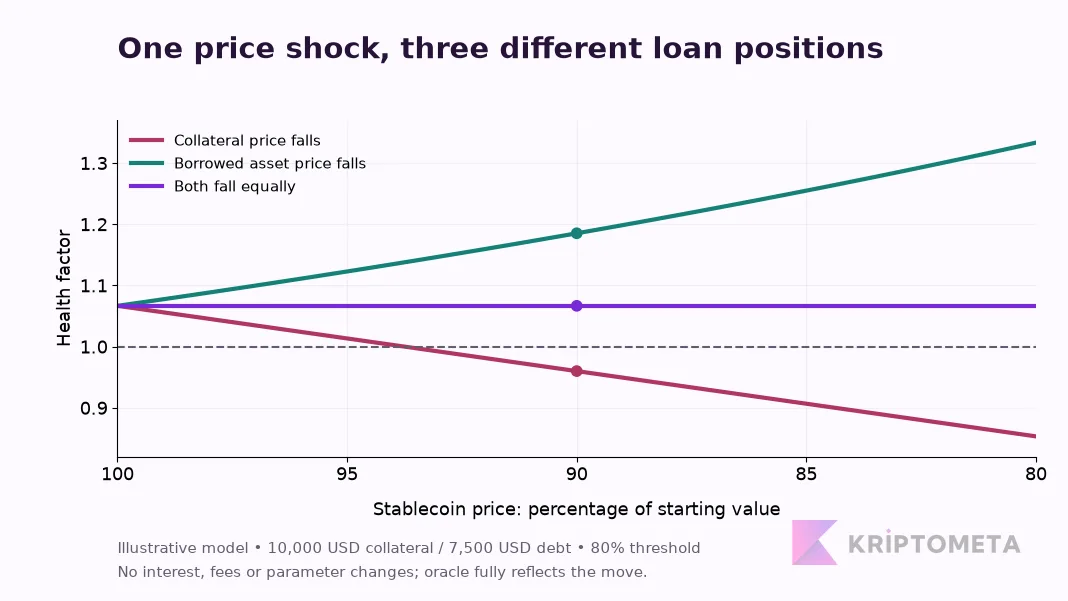
Illustrative sensitivity calculation, not a historical USDC chart. Quantities and the 80% threshold stay fixed on every line. The dashed line marks HF=1.
The first position crosses below 1. The second appears more comfortable, but a recovery in the borrowed token can increase its dollar liability again. The number of borrowed tokens does not shrink by itself. In the third, an unchanged ratio does not establish that liquidity, redemption access or execution costs stayed unchanged.
For the collateral-only case, the price multiplier at HF=1 is 7,500 ÷ (10,000 × 0.80) = 0.9375. A 6.25% decline in collateral price reaches the boundary. Reading the applicable threshold and debt load gives information that the word “stablecoin” cannot supply. The collateral and liquidation monitoring guide addresses day-to-day position checks.
Why a liquidation may increase the shortfall
Crossing a liquidation threshold is not the same as having uncollectible debt (bad debt). With enough collateral, repayment can improve the position. If realizable collateral is already worth less than the debt, a partial liquidation with a bonus can leave an even weaker collateral-to-debt ratio. Measure the uncollectible balance separately from the liquidation event.
Consider a hypothetical position with $9,400 of realizable collateral and $9,500 of debt. A liquidator repays $2,000 and receives $2,020 of collateral, including a 1% bonus. The remainder is $7,380 against $7,500: the simplified shortfall rises from $100 to $120. Fees are excluded, and 1% is not a universal protocol parameter. The calculation shows how debt can fall while the uncovered amount grows.
A difference between the oracle valuation and an executable sale price can make apparent collateral headroom misleading. Valuing an asset at $1 does not remove an economic loss; it may move exposure between users. Read the oracle mechanism alongside available market liquidity.
Risk controls act on different parts of the problem
Stopping new borrowing is not the same decision as stopping existing liquidations. In the March 11, 2023 governance discussion, BGD distinguished freezing new supply and borrowing on Avalanche from setting LTV to zero. Its explanation did not describe that LTV change as directly changing existing health factors. A recommendation, an implemented action and its effects require separate records.
Lower leverage, exposure caps and accumulated reserves address risk at different times. A parameter change presented as protective can abruptly reduce an existing borrower’s distance to liquidation. Revenue set aside is a buffer only if the funds are available and the rules permit their use. Expected future income is not cash available to cover a present shortfall.
Evidence that would change our assessment
- Recovery: redemption resumes, the price gap narrows and executable depth improves. Realized losses still require their own reconciliation.
- Persistent divergence: oracle valuations, exit liquidity and concentrated positions deteriorate together. Low aggregate borrowing can coexist with risk in a few large accounts.
- A shared shock: interconnected collateral assets weaken at the same time. Reserve and liquidity dependencies need to be mapped beyond a single token chart.
A defensible assessment needs position, oracle and market-depth records aligned in time. The historical case cannot predict today’s Aave loss or another protocol’s insolvency. Our Aave revenue and token-economics analysis asks a different question. Here the conclusion concerns the conditions under which a shock becomes someone’s loss, rather than a target price.