











NFT market analysis requires separating trading volume from independent demand. Sales counts, buyer distribution and the money reaching creators can tell very different stories.
Trading volume is the easiest NFT market number to spot. Who generated it is the harder question. Sales can accelerate while the buyer base narrows; a generous royalty rate can coexist with weak cash receipts. KriptoMeta's assessment starts with independent demand and repeatable revenue, rather than the size of a headline number.
The aim is to identify evidence of market strength or fragility, not to issue a price target. The numerical comparisons below are constructed examples. They do not represent current market totals or the performance of a real collection.
Why can volume rise while demand remains weak?
Volume adds up the value of counted sales over a defined period. Reselling the same asset repeatedly increases that total without necessarily bringing in new buyers. Collection prices also differ: a few expensive trades can exceed the volume of many lower-priced sales.
Comparisons need the same chains, marketplaces, time window and denomination. Unchanged ETH-denominated sales can become larger in US dollars when ETH appreciates. A rising dollar-volume chart does not, on its own, show an influx of collectors.
Wash trading, where counterparties are under common control, creates another problem. Chainalysis's 2022 study examined buyers funded by sellers. It is historical research, not a current market-size estimate. The method explains why address relationships matter, while a shared source of funds is not conclusive proof in every case.
Which indicators help assess genuine demand?
Unique buyer wallets can be more informative than transaction counts, but they are not a census of people. One person can operate many addresses, while a custody address can represent many customers. A growing wallet count may hide concentration in a small number of connected groups.
| Indicator | What it describes | What it does not prove |
|---|---|---|
| Filtered sales volume | Activity remaining after specified suspicious trades are excluded | That every remaining trade is independent |
| Unique buyer wallets | The distribution of purchasing addresses | An equal number of individual people |
| Returning buyers | Whether interest extends beyond a single day | Loyalty independent of rewards |
| Completed sales and bids | The gap between asking and paid prices | That every token can sell at the same price |
| Royalties actually received | Sale-related revenue reaching creators | That project expenses are covered |
The chart is only the output of a measurement method. When examining Dune dashboard queries and filters, check marketplace coverage, freshness and how bundled sales are counted. Two dashboards with different coverage may disagree without either difference proving manipulation.
The same 100 ETH, two different markets
Imagine collection A has 100 sales, 100 ETH of raw volume and 80 buyer wallets over a week. Collection B also has 100 sales and 100 ETH, but only 8 buyer wallets. The same screening method flags 10 ETH of A's volume and 70 ETH of B's volume as suspicious.
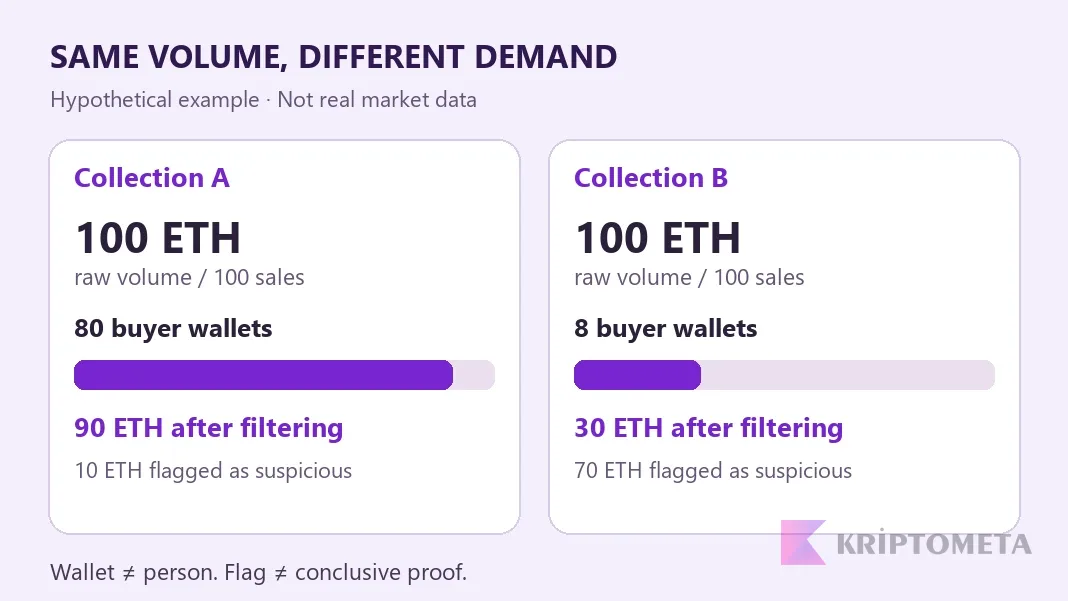
Volume after filtering is 90 ETH for A and 30 ETH for B. B's headline activity looks equally strong, yet its wallet concentration and larger excluded share warrant closer investigation. That does not make A a good investment automatically. File availability, rights, price and project expenses remain separate questions.
Why does the floor price not establish liquidity?
The floor price generally describes the lowest asking price among covered listings. It is not a standing commitment from a buyer. Removing the cheapest listing can raise the floor without any sale taking place. Executable bids, recent completed sales and sale frequency are more useful when considering an immediate exit.
A few rare items selling at high prices do not revalue every token equally. Multiplying the floor by the collection's supply produces a notional valuation that assumes all tokens could sell at that level. In a thin market, realized proceeds may fall far short of that figure.
When do creator royalties become sustainable revenue?
NFT creator royalties allocate a share of secondary sales to a designated recipient. ERC-2981 standardizes retrieval of royalty information, not proof that payment was collected. OpenSea's creator-earnings documentation distinguishes optional models from enforcement that depends on compatible contracts. That distinction was checked on September 25, 2026; platform rules can change.
If all eligible sales in a 100 ETH sample pay a 5% royalty, gross creator receipts are 5 ETH. If only 40 ETH of sales actually pay the rate, receipts are 2 ETH. Multiplying the headline rate by all volume ignores payment coverage. Neither result is profit before development, hosting and other costs are deducted.
For membership and gaming projects, usage outside resale activity matters too. If the sole reason to hold a token is the hope of reselling it for more, the project becomes increasingly dependent on new buyers. Useful access benefits can strengthen the case for holding, but cannot guarantee its resale value.
When reading NFT marketplace news, record the dates of royalty-policy changes. Revenue from periods governed by different rules should not be treated as directly comparable.
Three conditional scenarios for the NFT market
- More durable demand: Purchases become less concentrated, repeat usage persists, and filtered volume grows alongside collected revenue. The improvement should survive the end of short-term incentives.
- Temporary activity: Rewards or campaigns lift volume without a comparable increase in returning buyers or service usage. Post-campaign data becomes the deciding evidence.
- Fragile recovery: The floor rises while completed sales decline, bids thin out and purchases concentrate in fewer wallets. Asking prices may overstate the ability to exit.
For KriptoMeta, a constructive case needs indicators that corroborate one another. Independent buyers, continuing utility and realized income are stronger evidence than a volume record alone. Selecting an individual NFT still requires a separate check of its contract, license and wallet permissions.