










Tokenized gold gives access to gold exposure without moving bullion. For PAXG and XAUT, custody rights, total costs and a usable exit matter alongside the price.
Holding tokenized gold in a wallet is easier than evaluating the claim that comes with it. PAXG and XAUT may trade at similar prices, yet selling tokens, converting through an issuer and collecting a bullion bar are different exits. For a smaller holder, the practical question is often which exit is actually available—not whether both products use the word “gold.”
Reviewed September 30, 2026. This analysis examines issuer terms, fee schedules and reserve disclosures. We did not visit vaults, execute trades or test physical delivery. Numerical scenarios are explicitly hypothetical, not current quotes or return forecasts.
PAXG vs XAUT: where the difference matters
PAX Gold (PAXG) and Tether Gold (XAUT) move gold-related rights digitally. Tokenization does not remove the underlying price risk. The meaningful differences concern who recognizes the claim, how backing is demonstrated and what it takes to convert tokens into money or bullion.
| Check | PAXG | XAUT |
|---|---|---|
| Issuer | Paxos Trust Company, N.A. | TG Commodities, S.A. de C.V. |
| Gold unit | One fine troy ounce per token; allocated bar interest | One fine troy ounce per token; interest in a specified bar |
| Vault location | Professional London vaults | Bullion vaulted in Switzerland |
| Reserve disclosures | Monthly attestations; KPMG in the current directory | Quarterly reserve reports with BDO assurance |
| Issuer exit | Eligible customers: USD, allocated or unallocated gold | Whole-bar delivery or a broker-assisted bar sale |
| Small-balance question | Which conversion can I access beyond an exchange sale? | Where can I sell without reaching whole-bar size? |
The comparison draws on the PAXG product page, Paxos terms, Tether Gold terms and both reporting pages. Equivalent metal units do not imply equivalent onboarding or delivery services.
A fractional token is not a fractional delivery service
Direct physical redemption operates at whole-bar scale. Paxos specifies 430 PAXG plus fees per bar. Tether Gold may request 430 XAUT, with reconciliation against the actual bullion weight. Its route offers delivery in Switzerland or an attempt to sell the bar through a broker.
The relevant unit is a wholesale bar, not a small retail coin. The LBMA Good Delivery definition permits 350–430 fine troy ounces of gold. Digital divisibility should not be mistaken for a matching physical delivery service.
Assume gold is $4,000 an ounce purely to illustrate scale. Half a token represents $2,000 of metal, while 430 tokens represent $1.72 million before fees. For a small position, “I can always collect the gold” may not be a workable fallback through the issuer. A third-party retailer offering smaller deliveries would have its own pricing, geographical limits and contract.
Selling on a market transfers tokens to another buyer. Redeeming involves the issuer’s process for releasing the backing. An exchange sell button does not establish that the issuer will accept that customer for cash conversion or physical delivery.
Read the reserve date alongside the assurance scope
The current Paxos reporting directory lists monthly attestations and KPMG from February 28, 2025 onward. Tether Gold’s reporting page publishes quarterly disclosures. Frequency alone cannot rank safety; reserve attestations and financial statement audits address different scopes.
The June 30, 2026 Tether Gold report records 707,747.139 fine ounces against 707,747.09 minted tokens: 612,823.66 sold and 94,923.43 available for sale. BDO’s reasonable-assurance engagement covers that dated report, not a September 30 balance.
The analytical lesson is to distinguish minted supply, sold supply and exchange liquidity. Using only sold tokens as the denominator ignores backed inventory awaiting sale. A tiny rounding surplus in gold ounces is not an insurance fund against market losses.
The PCAOB advisory on reserve reports also cautions against substituting reserve verification for a financial statement audit. Evidence supporting a specific assertion is useful. It does not establish that every withdrawal will succeed or that every commercial risk has disappeared.
Separate exchange costs, network costs and issuer fees
An exchange commission, a blockchain transfer and issuer creation or redemption are different charges. The current Paxos fee schedule bases redemption fees on rolling 30-day net redemptions from September 1, 2026: 0.125% on the first $2 million, followed by marginal bands of 0.25%, 0.35% and 0.50%. It also lists a 0.05% in-kind conversion fee.
Starting with no previous net redemptions, a $3 million net redemption produces 2,000,000 × 0.125% + 1,000,000 × 0.25% = $5,000 under that schedule. Applying the last band to the whole amount would overstate the charge. The calculation excludes delivery, banking and other costs.
The Tether Gold fee schedule specifies a 50-token direct-purchase minimum and a 0.25% fee. Redemption carries 0.25% plus applicable delivery or brokerage charges. Verification also carries a non-refundable 150 USDt charge. Buying a fraction on an exchange is a different service from opening an issuer account.
For smaller balances, the bid–ask spread can matter more than a headline fee. Consider a hypothetical half-token trade with an ask of $4,040, a bid of $3,980 and a 0.10% commission each way. Assume the gold reference price is unchanged. These are not quotes from an actual exchange.
| Item | Calculation | Amount |
|---|---|---|
| Purchase value | 0.5 × $4,040 | $2,020.00 |
| Purchase commission | $2,020 × 0.10% | $2.02 |
| Sale value | 0.5 × $3,980 | $1,990.00 |
| Sale commission | $1,990 × 0.10% | $1.99 |
| Net difference | $1,988.01 − $2,022.02 | −$34.01 |
The position loses money despite an unchanged gold reference price. Add an assumed $8 transfer cost and the total becomes $42.01. Actual network costs vary; for an Ethereum transfer, the gas fee calculator can help evaluate that separate component. No issuer storage fee does not mean the whole transaction is free.
Why can a token lag a rise in gold?
A token can trade at a premium or discount to the metal it represents. Compare executable prices at the same time and in the same currency: (token price / represented gold value − 1) × 100. Comparing a USDT pair with a USD benchmark also requires accounting for the USDT/USD rate.
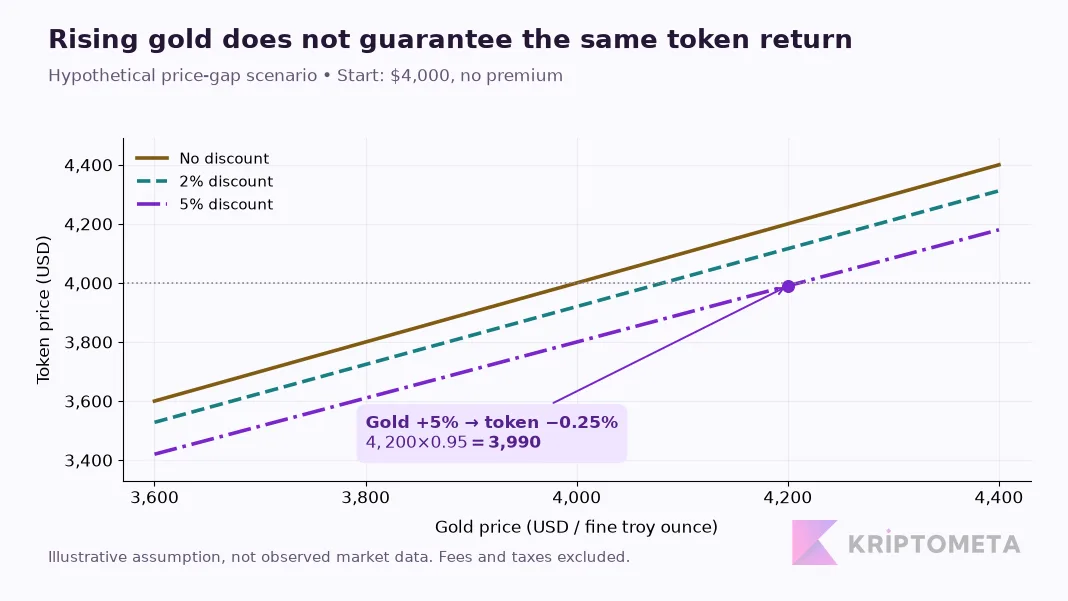
Illustrative calculation: starting gold price $4,000 per ounce, initial token premium zero. If gold rises 5% while the token moves to a 5% discount, its value is $4,200 × 0.95 = $3,990. Fees and taxes are excluded.
A price gap does not automatically prove missing reserves. Thin liquidity, interrupted transfers or concerns about access to redemption can also affect bids. Conversely, sufficient vaulted gold does not guarantee an immediate sale at the reference price. The PAXG market page and XAUT market page provide separate price views.
Which layer of custody risk are you taking?
A balance held at an exchange depends on that exchange’s withdrawal service. Moving it to your own wallet can remove that custody layer, but it does not remove the issuer, vault or token-administration powers. Paxos’s freeze and upgrade provisions and Tether Gold’s service restrictions remain relevant to a self-custodied token.
Insurance needs a scope check too. Tether Gold’s terms state that the custodian’s cover is not expected to cover all reserves and that holders may have to fund claims against the custodian themselves. Vault insurance is not the same protection as cover for a wrong-address transfer, a lost private key or an exchange failure.
Wrapping, bridging or lending the token introduces further dependencies. Check issuer-supported networks and authentic contract addresses rather than trusting a ticker alone. Borrowing against gold tokens also introduces the possibility that a price dislocation creates a collateral shortfall. Holding gold exposure and running a leveraged collateral position are different decisions.
What would change the assessment?
| Situation | Evidence to examine | Interpretation |
|---|---|---|
| Normal operation | Current scoped reserve evidence, functioning exit, executable spread | Digital transfer benefits remain; gold price risk remains too. |
| Liquidity pressure | Bid depth, withdrawal status, premium or discount | Value the amount you can sell, not merely the last displayed trade. |
| Redemption or eligibility problem | Issuer notices, customer acceptance, delivery and banking routes | Backing can exist while access is delayed; revisit the exit assumption. |
| Changed reserve assertion | Qualifications, changed scope, asset–liability mismatch | Do not carry a previous period’s conclusion forward unchanged. |
Jurisdiction belongs at the start of the assessment. Paxos’s product page says PAXG is currently unavailable in the EU. Tether Gold’s terms restrict direct services for U.S. persons, apart from specified exceptions. An English-language interface or an exchange listing does not prove that a U.S., European or other customer is eligible for issuer redemption.
KriptoMeta’s assessment is that the usable exit and its total cost matter most for a small holder. Someone seeking physical delivery must first resolve bar size and delivery location. Someone seeking on-chain gold exposure must resolve issuer rights, supported networks and executable market pricing. The documents do not support naming one universally safer token for every reader.