













Easy entry does not guarantee a quick exit. We inspect Lido’s public screens and calculate how transaction costs can change the decision for a small ETH position.
For this Lido review, we started with the exit rather than the advertised return. Getting stETH is straightforward; getting spendable ETH back on a deadline is a different problem. We examined the staking form, wrapping screen and withdrawal flow together, then worked through how network costs affect a small position and how a market discount changes an urgent exit.
Review scope: On 3 October 2026, we opened the official Ethereum interface’s Stake, Wrap, Request and Claim sections without connecting a wallet. The three screenshots below are our browser captures. We did not deposit funds, sign transactions or measure a completed withdrawal. The subject is Lido Core staking, not a performance test of Earn vaults or individually configured stVaults.
Who is Lido Core useful for?
Lido gives an ETH holder a transferable staking position without requiring them to operate a validator. That removes some operational work but introduces dependencies on pooled validators, contracts and accounting. It is a different risk exposure from simply holding ETH in a wallet.
Start with the difference between Lido, stETH and LDO. Buying LDO does not create the position shown in the ETH staking form. A prospective stETH holder has three practical questions to answer: how much ETH to allocate, how long they can leave it committed and which exit route they would use when they need it.
| Need | Assessment of Lido Core |
|---|---|
| Hold ETH exposure while participating in staking | Worth evaluating for someone who accepts contract risks and can accommodate a withdrawal queue. |
| Make a payment of a fixed ETH amount tomorrow | A poor match for deadline-driven liquidity. Protocol withdrawals take time; a fast swap can sacrifice value. |
| Use a DeFi application that accepts wstETH | Provides a compatible token; the next application adds its own collateral, liquidation and contract risks. |
| Try staking with a small balance for a short period | Calculate round-trip network costs before comparing rates. A simple interface does not establish an economic advantage. |
The staking form: what to check before submitting ETH
Entering 1 ETH in the official Stake form displayed 1 stETH as the amount to receive. The conversion, estimated transaction cost and reward fee appeared as separate rows below it. Without a wallet, we could inspect these fields, but could not verify an account balance or the final cost of an actual signed transaction.
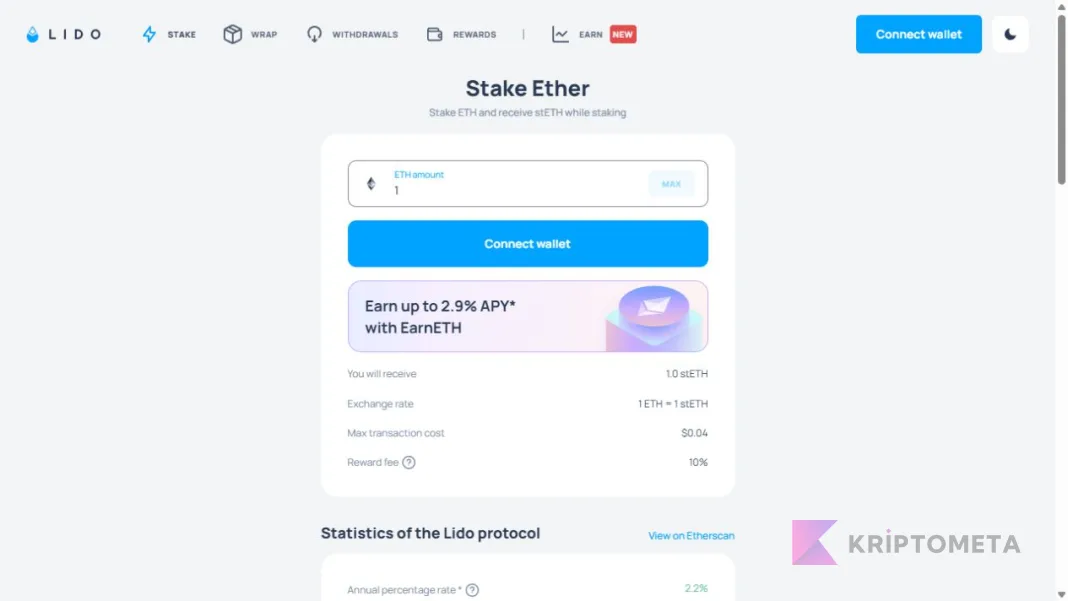
Wallet-disconnected view, 3 October 2026. The 1 ETH amount is a form input, not a deposit we made. Rates and network estimates are a dated snapshot.
- Verify the network and asset. This review covers ETH on Ethereum. A token with the same name on another network does not automatically have the same contract or withdrawal route.
- Leave ETH for gas. Allocating the entire wallet balance ignores transaction costs. Wrapping and eventual withdrawal can require additional ETH.
- Read the output token. A stETH balance and its dollar value are different measurements. Staking rewards can accrue while ETH loses market value.
- Compare the wallet request with the form. Check the account, destination contract, amount and network before signing. Recheck the official domain whenever returning to the application.
The interface earns credit for putting the reward fee beside the expected output. Its weakness is that promotions for different yield products can compete for attention on the same screen. We saw 2.2% APR in the protocol statistics and a separate EarnETH promotion advertising up to 2.9% APY. The second number is not the automatic return on holding stETH. Choosing whichever number is larger would compare different products.
Is the 10% fee charged on the deposit or the rewards?
The documented Lido Core protocol charge is 10% of staking rewards. Depositing 1 ETH does not mean only 0.9 ETH remains. The Lido documentation defines the user APR after the protocol’s reward fee. Deducting that same fee again from an already net user APR would understate the return.
Hypothetical example: Assume 1 ETH, a constant 3% gross annual rate and simple arithmetic. Gross rewards would be 0.03 ETH, the protocol share 0.003 ETH and the user’s reward 0.027 ETH. Real rates vary; this is not today’s quoted yield or a prediction.
The APR versus APY distinction matters when compounding enters the calculation. Rewards being put back to work and money left after all costs are separate questions. Taxes, wallet transactions and the eventual exit price sit outside a simple annual rate comparison.
| Calculation | 0.1 ETH | 1 ETH |
|---|---|---|
| Annual reward at a constant 2.7% user APR, simple calculation | 0.0027 ETH | 0.027 ETH |
| Assumed total network cost for entry and exit | 0.002 ETH | 0.002 ETH |
| Reward after that cost over one year | 0.0007 ETH | 0.025 ETH |
| Time to cover only that cost at the fixed rate | About 270 days | About 27 days |
The calculation is total cost divided by annual reward, multiplied by 365. It holds ETH’s price, the rate and fees constant and excludes compounding, taxes, penalties and market discounts. 0.002 ETH is an illustrative assumption, not a current Lido fee. It shows why the same fixed expense matters more to a small balance. Check Ethereum gas costs before acting and use the wallet’s transaction estimate for the actual operation.
stETH or wstETH: why does wrapping produce fewer tokens?
A stETH balance can change through protocol accounting. A wstETH balance does not increase by itself; the amount of stETH represented by each token changes instead. The official wstETH explanation describes a different accounting format, not a second reward stream. Wrapping does not add another staking yield on top.
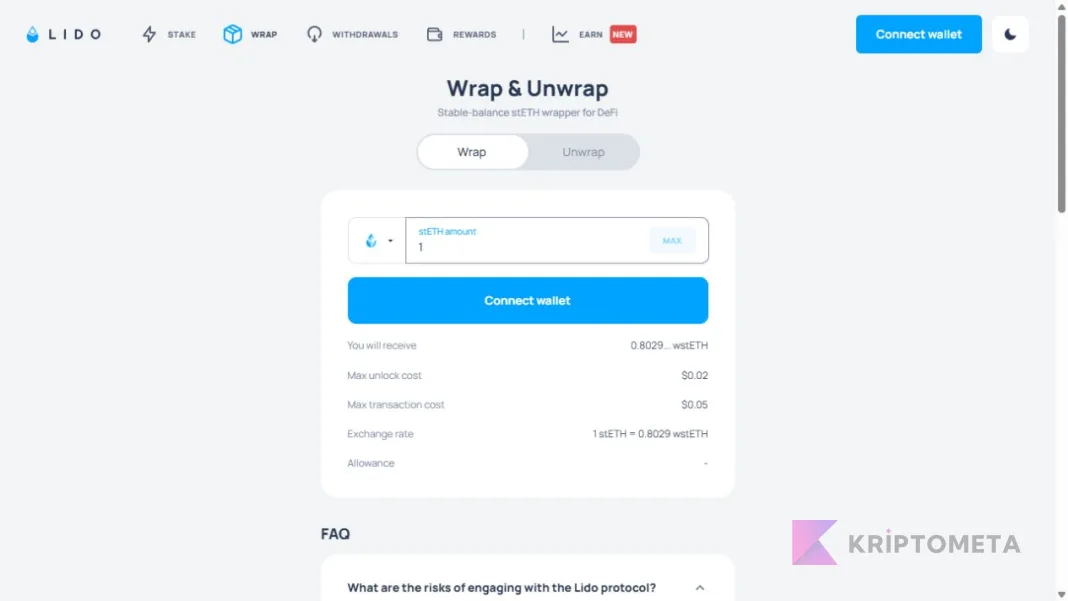
Wrap screen, 3 October 2026. The conversion and estimated approval and transaction costs are separate fields. No wallet was connected, so Allowance did not represent an inspected account’s permissions.
The displayed rate was approximately 0.8029 wstETH per stETH. Receiving fewer tokens is not enough to establish a loss: each wstETH can represent more than one stETH. For easier arithmetic, take a hypothetical rate of 1 wstETH = 1.25 stETH. Wrapping 1 stETH gives 0.8 wstETH; unwrapping at that unchanged rate returns the equivalent of 1 stETH. A changed rate changes the result.
Allowance concerns a contract’s permission to spend a token. Depositing native ETH and wrapping existing stETH are not identical permission flows. Depending on the route, a token approval or permit signature may appear. A gasless signature can still grant authority: read the asset, spender and amount in the wallet before approving it. Our token approval review guide covers how to inspect existing permissions.
Unwrapping is not an ETH withdrawal. Turning wstETH into stETH still leaves another step if you need ETH. On another network, bridge arrangements and local token contracts can also differ. The token integration documentation is a useful starting point for checking the network-specific representation instead of relying on a ticker alone.
Withdrawing ETH: why Request and Claim are separate
The withdrawal screen puts two exit routes side by side. During our inspection, the Lido route showed about five days and the DEX route about 30 seconds. Those were interface estimates, not timings from completed transactions or guaranteed service levels.
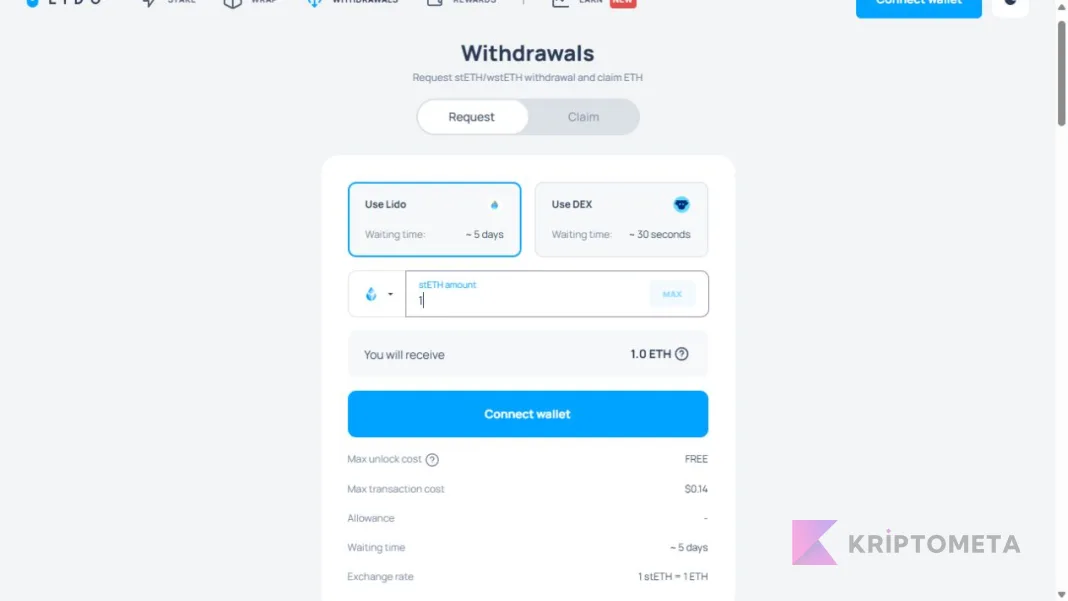
Withdrawal form captured on 3 October 2026. Use Lido is a protocol queue; Use DEX is a market swap. Request and Claim are separate stages of the protocol route.
- Request: Select the stETH or wstETH amount. The withdrawal flow handles wstETH’s conversion to its stETH equivalent internally; a separate unwrap transaction is not always required.
- Wait: The request enters the queue and receives an NFT representing the withdrawal right. The submitted position no longer earns additional staking rewards while waiting.
- Claim: Once finalised, the request becomes claimable and ETH can be collected. The Claim page required a wallet to show personal requests. We did not create an image of a completed claim or claim to have received funds.
The withdrawal contract rules make the request irreversible through cancellation. Transferring its NFT transfers the claim right; it should not be treated as a souvenir. Normal stETH-to-ETH accounting also does not guarantee an unchanged payout under adverse penalty conditions.
A request can have no protocol withdrawal fee while still requiring Ethereum transaction costs. Consider the request, any needed token permission and the final claim together. A field labelled “FREE” does not establish a zero-cost round trip.
Wait for redemption or accept a market quote?
Suppose a DEX offers a hypothetical net quote of 0.995 ETH for 1 stETH. That is 0.005 ETH below the normal 1 ETH protocol accounting value; any expenses excluded from the quote widen the gap. Waiting may avoid that market discount but postpones access and leaves protocol risk in place. An ETH payment due tomorrow cannot be planned around APR alone.
For a swap, compare the minimum output, final quote and all charges. For protocol redemption, monitor the current queue and request status. A transferable token is not a promise that every exit will preserve the same value at every moment.
Security assessment: what an audit does not establish
The public audit repository allows readers to inspect review work; it does not remove the possibility of loss. Match a report’s contract, version and scope to the product you actually intend to use before treating its existence as a security conclusion.
- Contracts and accounting: Software faults, data dependencies and governance changes can affect behaviour.
- Validator performance: Slashing and other penalties can reduce rewards or underlying stake. Multiple operators do not eliminate common infrastructure failures.
- Market and timing: stETH can trade away from ETH on secondary markets; protocol withdrawals remain queue-dependent.
- Additional applications: Borrowing against wstETH adds liquidation exposure and another contract layer compared with holding the token alone.
Lido’s public risk disclosure separates these dependencies and notes that legal treatment varies by jurisdiction. Website access does not establish that every use is authorised where you live. This review is not an independent code audit, deposit protection assessment or personal investment suitability determination.
Dated operational note: Lido’s 30 September 2026 disclosure reported precautionary exits of validators operated by MetaMask Staking, with potential foregone rewards and penalties. Its roughly 45-day cycle estimate was not a withdrawal deadline for every stETH holder. Our report on the validator exits distinguishes the stages. We do not treat the incident as resolved or harmless on this review date.
Strengths, limitations and the alternative that fits the job
Strengths: Entry, wrapping and exit have distinct sections; the reward fee is visible; token and contract documentation can be inspected. A reader can examine the core form before connecting a wallet. That is a useful starting point for someone who does not want to manage validator infrastructure.
Limitations: Network costs can dominate small positions. Protocol exit is not immediate. stETH, wstETH and Earn products appearing in one environment create room for confusion. Wrapping, moving between networks and using DeFi each add permission or risk decisions.
The useful comparison is which responsibilities you want to assume, rather than which screen displays the highest number. Keeping ETH in a wallet produces no staking reward but adds neither a staking pool nor its withdrawal queue. Operating a validator puts infrastructure work on you. Exchange staking introduces the provider’s custody and service terms. Our staking methods comparison examines those trade-offs separately.
KriptoMeta’s assessment: Lido Core is worth considering for an ETH holder who understands the token accounting and can keep exit timing flexible. It is a weaker fit for a small balance moved frequently or a fixed ETH obligation due soon. Whether protocol growth benefits LDO holders is another question, covered in the Lido and LDO analysis.