

















Comparing liquid staking with solo staking on Ethereum starts with control and the route back to ETH. Reward rates need to be read alongside expenses, queues and executable token prices.
A staking choice cannot be settled by comparing the reward rates on two screens. When you need the funds, who operates the validator and how you exit can all change the outcome. This guide covers Ethereum: “direct staking” means solo operation of your own validator, rather than native delegation models on other networks.
Who controls the keys and runs the validator?
Solo staking requires at least 32 ETH to activate a validator and working client infrastructure. Key management, updates, connectivity and monitoring are your responsibility. Avoiding a service provider’s share of rewards does not remove hardware and electricity expenses.
In a liquid staking pool, operators run the ETH validators while you hold a token representing your staking position. Ethereum’s pooled staking documentation describes pools as separate systems built above the base protocol. Holding the token in your wallet does not give you control of the validator client or operator keys.
| Decision point | Solo staking | Liquid staking pool |
|---|---|---|
| Starting capital | At least 32 ETH for validator activation | A lower, pool-specific minimum may apply |
| Operation | User manages clients and keys | Operator runs validators; user holds receipt token |
| Costs against rewards | Hardware, electricity, connectivity and maintenance | Service/protocol fee; transaction and potential sale costs |
| Exit | Network exit and withdrawal process | Protocol redemption or market sale of the token |
| Additional risks | Personal operation and key errors | Pool contracts, operators and token markets |
Staking as a service is a third arrangement: another operator runs your validator. It is not identical to solo staking. Retaining withdrawal credentials does not remove signing and operating dependencies. Check who holds each authority before relying on the product label.
What amount does the liquid token represent?
Rewards do not increase the token count in every model. A rebasing token such as stETH can change the wallet balance; a wrapped representation such as wstETH keeps its quantity fixed while its stETH conversion rate changes. The wstETH documentation explains this fixed-quantity model. Watching only the token count can hide rewards or losses.
Track three separate values: token quantity, the ETH represented by the protocol claim, and the ETH actually available from a market sale. A wallet’s US dollar estimate is a fourth measure exposed to price movements. Issuing another token or changing the wrapping format does not itself create additional economic yield.
Plan the exit: queue or executable sale price?
Stopping a solo validator does not make the ETH immediately spendable. Ethereum’s withdrawal rules distinguish validator types and network queues. Legacy 0x01 validators automatically sweep excess balances above 32 ETH, while compounding 0x02 validators can have an effective balance up to 2,048 ETH. Treating 32 ETH as every validator’s maximum is outdated.
A liquid token offers two distinct routes. Protocol redemption follows the contract’s request and completion process. A market sale requires a buyer and an acceptable price. For Lido, the withdrawal queue represents a request with an NFT; reserved ETH can be claimed after finalization. The locked amount earns no staking rewards while waiting and remains exposed to losses. Do not assume other pools implement the same details.
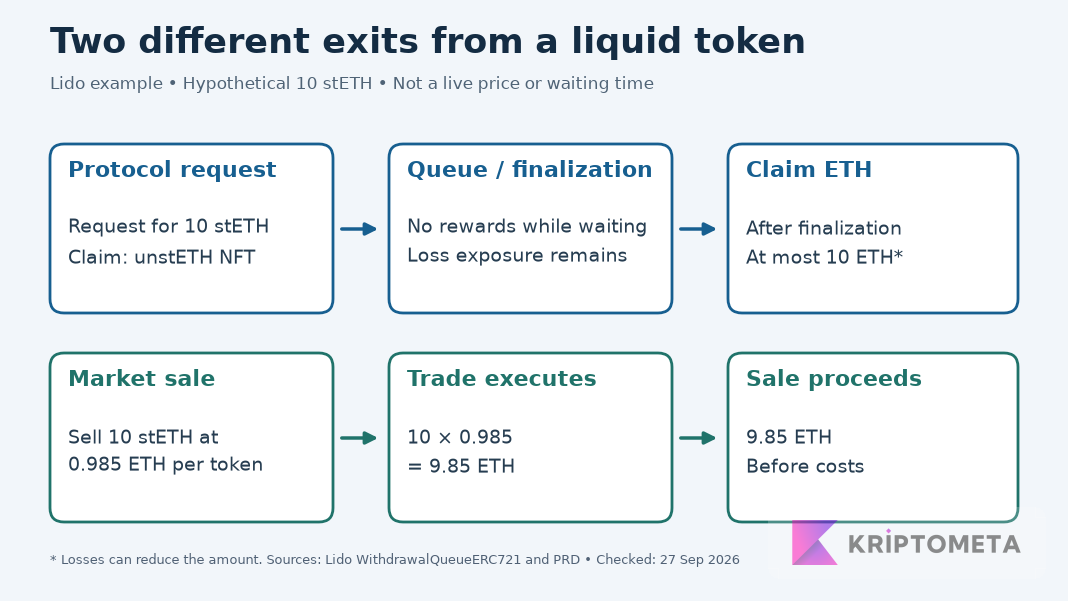
Suppose 10 stETH can be sold for 0.985 ETH each. The sale produces 9.85 ETH before costs. An accounting claim of 10 ETH does not erase the 0.15 ETH market difference. Protocol redemption instead involves time, potential losses and transaction costs; this example does not promise an immediate or guaranteed 10 ETH payment.
Check the total executable amount alongside the displayed price. A price available for a small trade may not survive a larger order. Price impact differs from slippage, the change between a quote and execution. If you have a fixed spending date, do not build the plan around an uncertain queue taking zero time.
Compare the same gross rate after costs
In a hypothetical comparison, 32 ETH earns 1.28 ETH over one year at a simple 4% gross reward rate. A liquid pool charging 10% of rewards would deduct 0.128 ETH, leaving 1.152 ETH. Solo operation costing 0.12 ETH annually would leave 1.16 ETH. The close result shows why “no service fee” is not enough to establish the better net outcome: if solo costs exceed 0.128 ETH, the pool leads under these assumptions.
The 4% rate and 0.12 ETH cost are not current offers. We assumed equal performance and uninterrupted participation, excluding compounding, taxes, penalties, entry/exit gas and sale discounts. Add those separately to a real cost comparison. Lido’s fee documentation provides an example of a rewards-based charge; it does not establish a universal pool fee.
The Lido analysis examines the operator and DAO allocation alongside H1 2026 financial data.
In the staking and APR/APY calculator, entering 32 ETH, 4% APR, 365 days and no compounding produces the same 1.28 ETH gross result. Deduct pool charges or solo operating costs separately; the calculator does not subtract them automatically.
Fixed transaction costs can matter as much as the rate for a small position held briefly. A $20 total exit cost on a $2,000 position equals 1% of principal. A high annualized rate does not mean a few days of earned rewards have already covered that cost.
Check the risk layers in order
The first layer is the network and validator behavior: downtime, invalid signing and withdrawal queues. The second is the service: contract upgrade powers, operator selection and emergency pause mechanisms. The official risk disclosure explains why audits or a large operator count do not remove every failure possibility.
The third layer is what you do with the token. Pledging it as collateral adds liquidation risk; moving it to another network adds bridge dependencies. Holding a staking token and running a leveraged strategy should not be presented as one exposure with one risk level.
Turn the choice into three concrete questions
- Can I operate a validator? Solo staking may be viable with at least 32 ETH, secure key management and ongoing maintenance capacity. Meeting the capital threshold alone is insufficient.
- When do I need the ETH? A flexible date may make a protocol queue manageable. A fast exit requires checking an actual sale quote, discount and gas cost.
- Which extra dependencies am I accepting? A high rate is inadequate evidence if the pool’s code, upgrade powers, operators and withdrawal method are not understood.
Write down the chosen model, expected holding period, cost assumptions and emergency exit route. Revisit the same note when costs or control structures change. Choosing a staking method does not remove ETH price risk; it makes the required work and exit costs visible alongside the reward figure.
